
Table of Contents
- What Separates Gold Jewelry Investment Pieces From Fashion Jewelry
- The Cost Per Wear Jewelry Calculation That Changes Everything
- How to Identify High-Quality Gold Jewelry: Hallmarks, Karats, and Craftsmanship
- Resale Value and Liquidity: What Actually Sells
- Styling Statement Necklaces 2026: Making Fashion Pieces Work Harder
- Tax, Insurance, and Maintenance: The Costs Nobody Talks About
- Conclusion
- Frequently Asked Questions
Last Updated: September 26, 2026
What Separates Gold Jewelry Investment Pieces From Fashion Jewelry
Gold jewelry investment vs fashion pieces comes down to one question: are you buying metal or buying a look?
Investment pieces hold intrinsic value in their metal content; fashion pieces sell design and trend appeal at a price that rarely comes back. Both have a place in a jewelry box, they just do different jobs.
That distinction matters more in 2026: gold prices have climbed, resale platforms have made secondhand jewelry easier to move, and a $60 necklace and a $600 necklace can look identical on day one yet be worth wildly different amounts on day 400.
Intrinsic Value: Melt Value vs. Retail Markup
Intrinsic melt-value is what a piece is worth sold purely for its metal content; retail price bundles metal, labor, design, branding, and margin. The two are rarely close: a solid gold chain might carry a retail markup several times its melt value, while a plated necklace has a melt value near zero because the gold layer is microns thick. Investment pieces pay for metal with a floor value; fashion pieces pay for design, finish, and the moment. Neither is a scam, confusing one for the other is where buyers get hurt.
Materials That Hold Up: Solid Gold, Vermeil, and Plated
Solid gold means the entire piece is gold alloy, measured in karats. Vermeil is sterling silver with a thick gold layer, usually at least 2.5 microns. Gold plating is a thin gold layer over a base metal like brass or copper.
The durability gap between these three is enormous.
- Solid gold resists tarnish, holds resale value, and can be repaired or resized by a jeweler
- Vermeil wears well for years if the plating is thick, but it can eventually wear through at high-friction points
- Plated pieces are the most affordable and the most likely to fade, flake, or discolor with daily wear
The honest trade-off: plated jewelry gives you the look of gold at a fraction of the price, and asks you to accept a shorter lifespan.
The Cost Per Wear Jewelry Calculation That Changes Everything
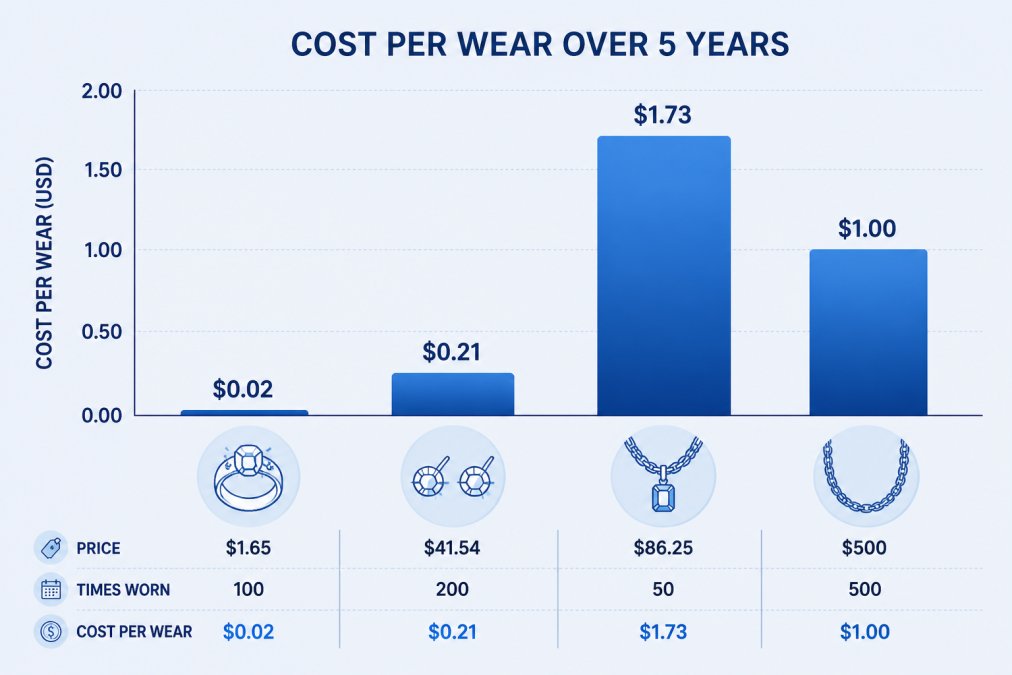
The cost per wear jewelry calculation is the most useful number here: divide the price you paid by the number of times you actually wear the piece.
How to Identify High-Quality Gold Jewelry: Hallmarks, Karats, and Craftsmanship
Learning how to identify high-quality gold jewelry takes ten minutes: start with the hallmark, check the karat, then inspect the craftsmanship.
Craftsmanship shows up in the details most shoppers skip:
- Clasps that feel solid rather than flimsy
- Settings where stones sit flush and don't wobble
- Smooth solder joints with no visible pits or discoloration
- Even plating with no patchy or dull spots
Resale Value and Liquidity: What Actually Sells
Resale is where the investment argument holds up or collapses. Liquidity describes how quickly you can convert a piece into cash without a heavy loss, and why the number on a receipt is almost never what you get back.
Melt Value vs. Retail Value: The Gap Nobody Explains
When you sell gold jewelry, you are almost never selling it as jewelry, you are selling it as metal. The buyer, whether a pawn shop, gold dealer, or online refinery, calculates melt value and offers a fraction of it:
- Melt value is the spot price of gold multiplied by the piece's actual gold content. A 14k chain weighing 10 grams contains roughly 5.8 grams of pure gold. If spot gold is $2,400 per ounce (about $77 per gram), melt value is roughly $447.
- Dealer spread is the discount the buyer applies to protect their margin and cover refining. For scrap gold, that spread commonly runs 10% to 30% below melt value, so that $447 chain might fetch $310 to $400.
- Retail value is what a store charges for a comparable new piece, often two to four times melt value, including labor, design, branding, and retail margin.
Where Liquidity Actually Exists
Not all gold jewelry sells the same way. Liquidity depends on the channel:
- Scrap gold buyers and pawn shops offer the fastest cash but the lowest percentage of melt value. Convenience has a cost.
- Online refineries often pay closer to melt value but take longer and carry shipping risk.
- Private sales (marketplace apps, estate sales) can fetch closer to retail for desirable pieces, but only if the piece has design appeal, a recognized brand, or gemstones with independent value.
- Auction houses work for high-value, branded, or antique pieces, but charge seller's premiums that can eat 15% to 25% of the hammer price.
The Depreciation Curve
Fashion jewelry depreciates instantly: the moment you leave the store, the retail markup evaporates, with no metal value as a floor.
Styling Statement Necklaces 2026: Making Fashion Pieces Work Harder
Styling statement necklaces 2026 is about making a low-cost piece carry a high-impact look, maximum visible style per dollar spent.
Three approaches work consistently well:
- Layer by scale, not by price. Pair a bold gold-plated statement piece with thin chains. The contrast reads intentional, and nobody is checking the karat stamps.
- Anchor the outfit, not the jewelry. Let the necklace be the loudest element. Keep the rest of the look clean so the piece does the talking.
- Match the finish to the occasion. High-shine gold plating suits evening and streetwear. Brushed or matte finishes read better for daytime.
Tax, Insurance, and Maintenance: The Costs Nobody Talks About
Two costs rarely appear in buying guides: tax treatment and insurance. Both shift the math between investment and fashion pieces.
Insurance: When You Need a Rider and What It Costs
Homeowners and renters policies typically cap jewelry coverage at $1,000 to $2,500 for theft, with lower limits for mysterious disappearance. If your collection exceeds that cap, you need a scheduled personal property rider or standalone jewelry policy. How it works:
S925 Silver White Rose Jade Stud →
- You provide an appraisal or receipt for each scheduled piece.
- The insurer charges an annual premium, commonly 1% to 2% of insured value, though rates vary by location, security, and claims history.
- A $5,000 solid gold chain might cost $50 to $100 per year to insure, $500 to $1,000 over a decade, a real cost of ownership.
- Some policies require a recent appraisal every few years, which costs money and time.
Tax Treatment: What You Owe When You Sell
In the United States, gold jewelry held for investment is generally treated as a collectible for capital gains: long-term gains can be taxed up to 28%, versus 20% for most other long-term assets, and short-term gains are taxed as ordinary income. Most people never report jewelry sales, but a gain above what you paid is technically taxable; a loss may be claimable, though personal-use property rules are restrictive.
Maintenance: The Ongoing Cost of Ownership
Maintenance splits the same way as insurance and tax.
Solid gold needs occasional professional cleaning and inspection. A jeweler might charge $30 to $75 for ultrasonic cleaning and a prong check; settings loosen over time and a lost stone is expensive. For daily-wear pieces, an annual inspection is prudent.
The True Cost Equation
The true cost of a jewelry purchase is price plus insurance plus maintenance minus resale value. Run all four numbers before calling anything an investment.
-
Price: $5,000
-
Insurance: $500 to $1,000 over ten years
-
Maintenance: $300 to $750 over ten years
-
Resale value: maybe $2,000 to $3,000 depending on gold prices and dealer spread
-
Price: $60
-
Insurance: $0
-
Maintenance: $0
-
Resale value: $0
Conclusion
Most jewelry advice treats this as a binary: buy cheap and accept it won't last, or spend big and hope it appreciates. The smarter move is matching each piece to the job it does and running the cost per wear math honestly before you commit.
Frequently Asked Questions
Is it smart to buy gold jewelry as an investment?
Only if you buy solid gold pieces with clear hallmarks and low retail markup. Most gold jewelry loses 40-60% of its retail value the moment you leave the store because of markup, labor, and design fees. The gold itself holds intrinsic melt-value, but you rarely recover the full price unless the piece is rare, signed, or has strong secondary market demand. For pure investment, gold bullion or coins work better. For wearable value, focus on pieces you will actually wear often enough to lower your cost per wear.
How can you tell the difference between gold-plated and solid gold jewelry?
Check the hallmark. Solid gold pieces carry stamps like 10K, 14K, 18K, or 24K, indicating the gold content. Gold-plated items usually say GP, HGE, or gold-filled, meaning a thin layer of gold over a base metal like copper or brass. Solid gold feels heavier, resists tarnish, and can be resized. Plated pieces are lighter, may tarnish over time, and cannot be resized without damaging the plating. A jeweler can test with acid or a magnet to confirm.
Does fashion jewelry hold any resale value?
Fashion jewelry rarely holds resale value. Pieces made from base metal, gold plating, or vermeil typically sell for a fraction of their retail price on secondary markets. The exception is designer or limited-edition costume jewelry from recognized brands, which can sometimes appreciate. For everyday fashion pieces, think of them as consumables: you buy them for style and wear them until they wear out. Their value comes from use, not resale.
How do you care for investment gold versus fashion pieces?
Solid gold needs minimal care: warm water, mild soap, and a soft cloth. Store separately to avoid scratches, and polish occasionally to maintain shine. Gold-plated and vermeil pieces need gentler handling. Avoid water, perfume, and harsh chemicals. Wipe with a dry cloth after wearing, and store in an airtight bag to slow oxidation. Never use abrasive polishes on plated jewelry. With proper care, plated pieces can last years, but the plating will eventually wear thin with frequent wear.