
Table of Contents
- Why Buying Jewelry Online Feels Risky (And How to Fix That)
- How to Verify Online Jewelry Store Authenticity Before You Spend a Cent
- Master the Materials: Spotting Solid Gold, Sterling Silver, and Plating
- Questions to Ask Before Buying Jewelry Online: Your Pre-Purchase Checklist
- Secure Your Payment: Checkout and Digital Security Essentials
- Tips for Buying Unique Handmade Jewelry That Lasts
- Your Post-Purchase Safety Net: Verification, Returns, and Appraisals
- The Smart Shopper's Final Move
- Frequently Asked Questions
Why Buying Jewelry Online Feels Risky (And How to Fix That)
Most shoppers worry about buying jewelry online because they cannot physically inspect the piece before paying. This fear is justified: online scams and misrepresented products are common enough that consumer protection agencies publish dedicated guidance on the topic. The Federal Trade Commission's guidance on online shopping recommends verifying seller reputations and understanding return policies before any purchase.
The good news is that buying jewelry online safely comes down to a handful of verifiable checks. Once you learn to spot hallmarks, ask the right questions, and secure your payment, the process becomes far less intimidating.
At Omnia X, we built our model around making quality jewelry accessible without the guesswork, earning trust through transparent descriptions, clear specifications, and honest photography. Below, we'll show you how to apply the same scrutiny we welcome.
How to Verify Online Jewelry Store Authenticity Before You Spend a Cent
Authenticity verification starts with researching the seller's reputation, not the product. Look for a physical address, a working customer support channel, and independent reviews across multiple platforms. A legitimate retailer should also have a clear authenticity guarantee in writing.
Check whether the store belongs to recognized industry bodies or displays certifications on its website. Trusted retailers often link to their accreditation or explain their sourcing standards. If you cannot find basic business information, consider that a red flag.
Master the Materials: Spotting Solid Gold, Sterling Silver, and Plating
Understanding material quality is the single most important factor in verifying online jewelry store authenticity. Solid gold is stamped with hallmarks such as 10K, 14K, or 18K, while sterling silver carries a 925 mark. These stamps indicate metal purity and are legally required in most markets.
Gold-filled and gold-plated pieces differ from solid gold. Plating is a thin layer over base metal, which explains why cheaper jewelry tarnishes quickly. A hallmark does not tell you the construction method, so read the product description carefully for terms like "solid gold" versus "gold plated."
The international hallmarking guidelines from the British Assay Office explain how these stamps protect consumers. If a listing omits hallmark information entirely, ask the seller directly before purchasing.
Questions to Ask Before Buying Jewelry Online: Your Pre-Purchase Checklist
The best questions to ask before buying jewelry online are about materials, construction, and after-sales support. A reputable seller answers these clearly without hedging.
- What is the exact metal content, and is it solid or plated?
- Are gemstones natural, lab-grown, or simulated, and do they come with a grading report?
- What is the return policy, and are there restocking fees?
- Does the piece come with a warranty or authenticity certificate?
- How is the item packaged and shipped, and is it insured?
Secure Your Payment: Checkout and Digital Security Essentials
Digital security during checkout is non-negotiable, yet most guides stop at "look for the padlock icon." That advice is outdated. A padlock icon only confirms the connection is encrypted, it says nothing about who is on the other end. To protect yourself against fraud and identity theft, verify three distinct layers: the connection, the payment processor, and the seller's data-handling practices.
Layer 1: Verify the connection, not just the icon.
Click the padlock icon in your browser's address bar and inspect the certificate details. It should be issued to the domain you are actually on, not a parent company or a misspelled variant. For example, if you are shopping at example-jewelry.com, the certificate should list that exact domain. A certificate issued to example-jewelry-llc.net is a red flag. Also check that the certificate is not expired.
Layer 2: Confirm the payment processor.
Legitimate jewelry retailers almost always route payments through established processors like Stripe, PayPal, Shopify Payments, or Adyen. Before entering your card details, look for the processor's name on the checkout page or in the page source. A common scam is a fake checkout page that processes payments through an obscure third-party service. If you do not recognize the processor, abandon the cart and contact the seller directly.
Layer 3: Use a single-use virtual card number.
Most major credit card issuers (Chase, Capital One, Citi, Amex) offer virtual card numbers through their mobile apps or browser extensions. These generate a unique card number tied to a spending limit and expiration date you control. If a jewelry site is compromised after your purchase, the stolen number is useless to fraudsters. If your issuer does not offer virtual cards, consider using a dedicated low-limit credit card for online purchases only.
What about digital wallets and buy-now-pay-later services?
Apple Pay and Google Pay add tokenization, the merchant never sees your actual card number, only a device-specific token. This is generally safer than typing your card number into a website. Buy-now-pay-later services like Klarna and Afterpay offer buyer protection, but they can encourage overspending. If you use them, only purchase what you can afford to pay off within the promotional window.
The payment method hierarchy for jewelry purchases:
- Virtual credit card number (best: limits exposure even if the merchant is breached)
- Apple Pay / Google Pay (tokenized, no card number shared)
- Standard credit card (good: buyer protection under the Fair Credit Billing Act)
- PayPal (good: dispute resolution process, but slower than credit card chargebacks)
- Debit card (risky: funds leave your account immediately)
- Bank transfer / wire / cryptocurrency / gift cards (never: zero recourse)
One more check: the seller's privacy policy.
Before checkout, open the seller's privacy policy and look for a section on data security. Reputable retailers state whether they store payment information, whether they use PCI-compliant processors, and how they handle data breaches. If the policy is vague or absent, that is a strong signal the seller is not taking your financial data seriously.
The FBI's Internet Crime Complaint Center guidance on payment fraud notes that wire transfers and cryptocurrency are the top methods for unrecoverable fraud losses. A legitimate jewelry business will never pressure you into these methods. If a seller insists on them, end the conversation immediately.
Tips for Buying Unique Handmade Jewelry That Lasts
The tips for buying unique handmade jewelry differ from mass-produced purchases because each piece has individual character. Ask the seller about their crafting process, materials sourcing, and whether the piece is made to order. Handmade items often take longer to ship, so factor in production time if you need a gift by a specific date.
Sustainable and ethical sourcing matters more to buyers than ever. Sellers who use recycled metals or conflict-free stones usually state this openly. The responsible sourcing guidance from the Responsible Jewellery Council provides a framework for what ethical claims should include.
Your Post-Purchase Safety Net: Verification, Returns, and Appraisals
The moment your package arrives is when most buyers relax, and that is exactly when mistakes happen. The first 48 hours after delivery are your only window to catch discrepancies, file disputes, and protect your consumer rights. Here is a concrete post-purchase protocol that goes beyond "check the hallmarks."
Hour 0: The unboxing video (non-negotiable for pieces over $500)
Record a continuous, unedited video from the moment you open the outer shipping box to the moment you hold the jewelry piece in your hands. Do not cut the recording. Show the following in frame:
- The shipping label and tracking number
- The condition of the outer box (damage, tampering, or resealing)
- The interior packaging and any security seals
- The jewelry box or pouch
- The piece itself, close up, from multiple angles
- Any certificates, appraisals, or authenticity cards included
This video is your evidence if the seller claims the item was damaged in transit, or if you need to prove the item did not match the description. Most credit card dispute processes require documentation within 60 days, but sellers' return windows are often just 14-30 days. The video takes five minutes and protects you for months.
Hour 1: Verify against the listing, not your memory
Open the original product listing on your phone or computer. Compare the delivered piece against the listing's photos and description point by point:
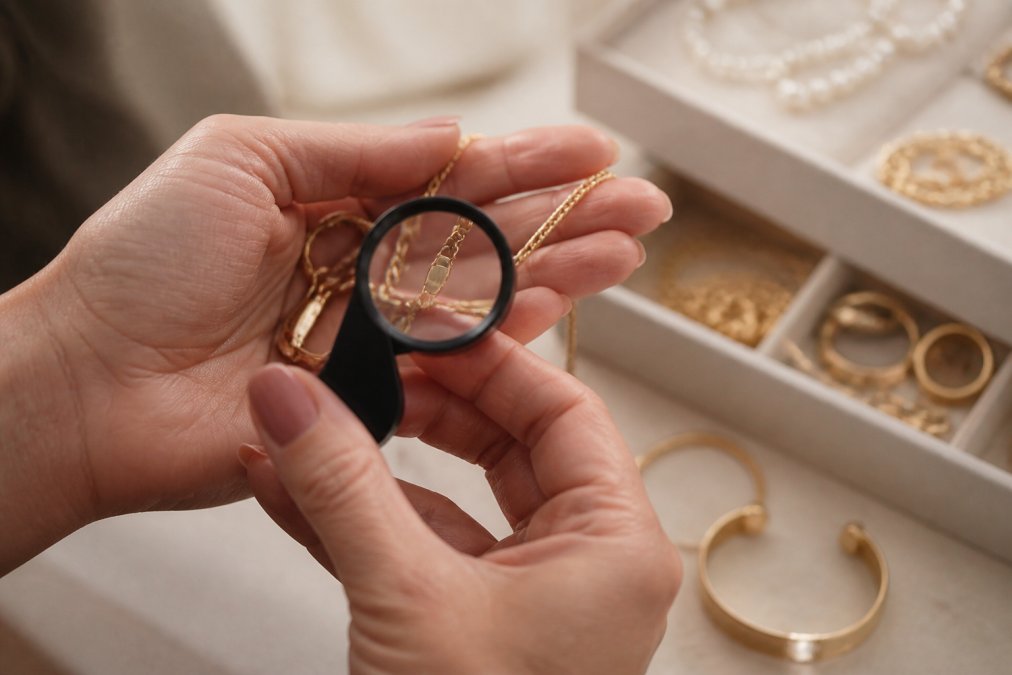
- Hallmarks: Use a jeweler's loupe (10x magnification, available for under $10) to check the stamp. For gold, look for 10K, 14K, 18K, or 24K. For platinum, look for PLAT or 950. For sterling silver, look for 925. If the hallmark is missing or differs from the listing, stop and photograph it immediately.
- Weight: If you have a kitchen scale that measures grams, weigh the piece. A significant deviation from the listed weight (more than 5-10%) can indicate hollow construction or a different metal than advertised.
- Gemstone color and clarity: Compare against the listing's photos in natural daylight. If the stone looks noticeably different, note it in writing.
- Length and size: For chains and bracelets, measure with a ruler. For rings, check the size against a ring sizer if you have one.
Hour 24: The independent appraisal window
For fine jewelry purchases over $1,000, schedule an independent appraisal within one week of delivery. A qualified appraiser (look for credentials from the American Gem Society or the International Gem Society) will verify the metal content, gemstone quality, and overall value. The appraisal confirms the piece matches the description and provides documentation you need for insurance.
If the appraisal reveals a discrepancy, for example, the diamond is graded lower than the certificate claims, you now have professional documentation to support a return or a partial refund. Without this step, you are relying on your own untrained eye against a seller who may have a polished dispute process.
Day 7: Insurance and documentation
Once the appraisal confirms the piece is as described, add it to your homeowner's or renter's insurance policy as a scheduled item. Standard policies often cap jewelry coverage at $1,500-$2,500, which is far below the value of fine jewelry. A scheduled rider costs roughly $1-$2 per $100 of insured value annually and covers loss, theft, and damage. Keep the following documents in a safe place (physical and digital backup):
- The original receipt and order confirmation
- The product listing screenshots
- The appraisal report
- The unboxing video (store it on a cloud service)
- Any certificates of authenticity or grading reports
The return policy as a safety net: know your deadlines
Return policies are only useful if you act within the window. Mark the return deadline on your calendar the day the package arrives, do not rely on memory. Before initiating a return, re-read the policy for these specifics:
- Who pays for return shipping? (Some sellers deduct return shipping from your refund.)
- Are restocking fees applied? (Some charge 10-20% for returns on custom or made-to-order pieces.)
- Is the refund issued to the original payment method, or only as store credit?
- Are there condition requirements? (Some require the original tags attached and packaging intact.)
If the piece is significantly not as described, you are not limited to the seller's return policy. Under the Fair Credit Billing Act, you can dispute the charge with your credit card issuer within 60 days of the statement date. This is a separate process from the seller's return policy, and it is your strongest recourse if the seller is unresponsive. Document every communication with the seller in writing, email is preferable to phone calls because it creates a record.
:::takeaway The post-purchase window is not passive waiting, it is an active verification period. A structured protocol of unboxing video, hallmark verification, independent appraisal, and insurance scheduling turns a risky purchase into a protected asset. Most buyers skip these steps and only regret it when a problem surfaces weeks later, after the return window has closed.
The Smart Shopper's Final Move
Confidence in buying jewelry online comes down to preparation. Research the seller, understand the materials, ask pointed questions, and protect your payment method. These habits separate a satisfying purchase from a costly mistake.
At Omnia X, we apply these same standards to every piece we curate. Our commitment to quality merchandise at competitive prices means transparent descriptions, honest material specifications, and responsive customer support. When you shop with us, you are not gambling on quality; you are choosing a retailer that values your trust.
Get started with Omnia X and find jewelry you can wear with confidence for years.
Frequently Asked Questions
How can I tell if an online jewelry store is legitimate?
Start by checking for a clear physical address, a working customer support line, and an 'About Us' page that explains who runs the business. Look for reviews on independent platforms, not just the store's own website. Confirm the store uses a secure checkout (look for HTTPS and a padlock icon). A legitimate store will also clearly state its return policy and provide authentication details, like hallmarks or certification, before you buy.
Is it safe to buy jewelry online?
Yes, buying jewelry online is safe when you take the right precautions. Buy from stores that offer secure payment gateways like PayPal or major credit card processors, which provide buyer protection. Verify the store's authenticity by looking for metal purity hallmarks, clear product descriptions, and return policies. For high-value pieces, ask about shipping insurance. Taking these steps significantly reduces the risk of fraud or receiving a product that differs from its description.
What should I look for when buying jewelry online?
Focus on the four Cs of safe online jewelry shopping: store reputation, material transparency, product verification, and return policy. Read customer testimonials to gauge the store's reliability. Look for specific metal stamps (like 14k or 925), detailed photos, and a grading report for any diamonds or precious gems. Ensure the store offers a clear return policy and a warranty, and confirm the payment method includes buyer protection before you finalize your purchase.
Why do you offer better prices than other online jewelry stores?
We keep our prices competitive by curating our collections directly and operating with lower overheads than traditional brick-and-mortar shops. This lets us deliver quality jewelry at a better value. We do not compromise on material quality; our pieces use genuine metals and stones, and we provide clear information on hallmarks and material composition. We also stand behind our products with a clear return policy and responsive customer support.