
Table of Contents
- Why Non Mass Produced Jewelry Is Worth the Extra Effort
- What You'll Need to Inspect Jewelry Like a Pro
- Step 1: How to Spot Handcrafted Jewelry by Its Surface Details
- Step 2: Signs of Quality Jewelry Craftsmanship in Construction and Finishing
- Step 3: Questions to Ask When Buying Handmade Jewelry (In Person or Online)
- Step 4: How to Verify Handmade Jewelry Claims With Marks and Paperwork
- Step 5: Common Mistakes and False Positives When Judging Non Mass Produced Jewelry
- Conclusion: Making a Confident Choice
- Frequently Asked Questions
Last Updated: October 13, 2026
Why Non Mass Produced Jewelry Is Worth the Extra Effort
Learning how to identify non mass produced jewelry starts with understanding what you're actually paying for. A handcrafted ring or necklace often costs more because a real person shaped it, set its stones, and finished it by hand. That work leaves marks you can learn to read.
At Omnia X, we built our curated jewelry collection around exactly this idea. We want shoppers to find pieces with real character at prices that make sense.
Mass-produced jewelry isn't automatically bad. It's just made differently. Machines stamp, cast, and polish thousands of identical pieces. That's why two budget rings from the same line look exactly alike.
Handcrafted pieces are different in three ways:

- Each piece varies slightly from the next
- A jeweler makes decisions along the way
- The finish reflects human hands, not a mold
So how do you tell them apart? Below, we'll walk through seven steps, from surface details to maker's marks to the questions you should ask before you buy.
What You'll Need to Inspect Jewelry Like a Pro
You don't need a lab to judge jewelry. A few simple tools and a bit of patience will do most of the work.
Gather these before you start:
- A magnifying loupe or a phone camera with macro mode
- Good lighting, ideally daylight or a bright lamp
- A small kitchen scale for comparing weight
- A soft cloth to check surface finish
- The product listing or receipt, if you're buying online
For online purchases, you'll also want clear, zoomed-in photos. Ask the seller for close-ups of the clasp, the stone settings, and any stamps if they aren't shown.
A common mistake is judging from one blurry photo. In practice, you need at least three angles to spot real differences.
Step 1: How to Spot Handcrafted Jewelry by Its Surface Details
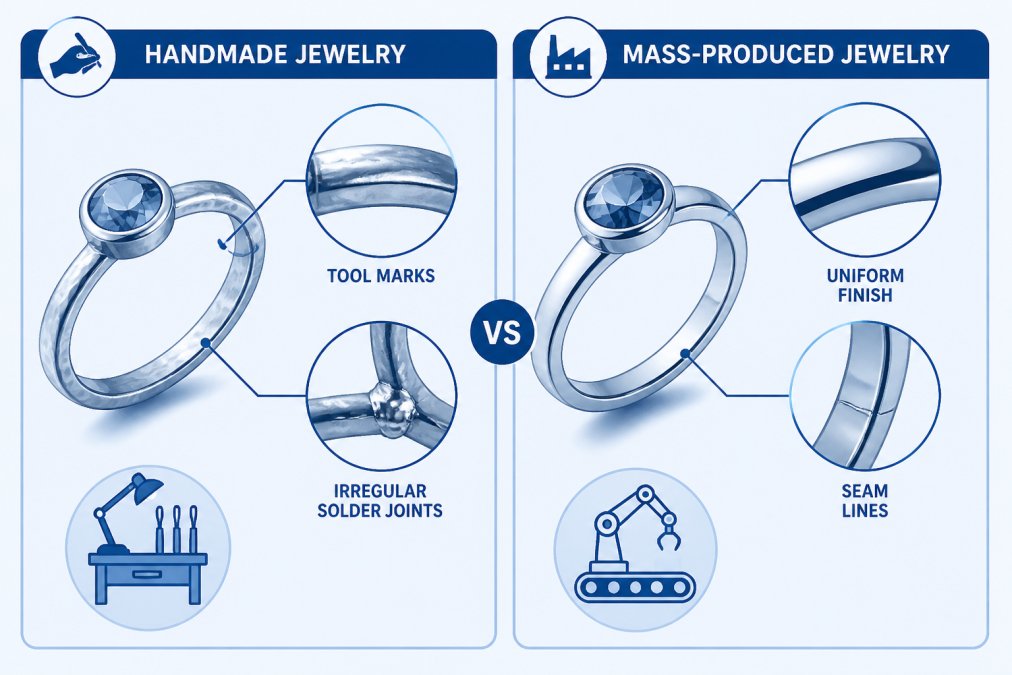
Surface finish is your first clue. Handcrafted jewelry usually shows small, uneven tool marks. Mass-produced jewelry looks perfectly smooth and identical every time.
Here's how to compare them:
| Detail | Handcrafted Look | Mass-Produced Look |
|---|---|---|
| Surface | Slight waves, hand-polished sheen | Mirror-perfect, uniform |
| Solder joints | Small, varied, sometimes visible | Hidden or seam-free |
| Edges | Softened by hand | Sharp, machine-cut |
| Texture | Unique per piece | Repeats exactly |
Run your fingernail along an edge. A handmade piece often feels gently rounded. A stamped piece can feel sharp or squared off.
Step 2: Signs of Quality Jewelry Craftsmanship in Construction and Finishing
Good construction holds up over time. Look at how the piece is built, not just how it shines.
Start with the setting. A hand-set stone usually sits in a seat that was cut to match that specific stone.
Check these areas with a loupe or macro photo:
- Prongs and settings: Stones should sit tight, with even prongs. Look for gaps between the stone and the metal seat. A glued stone often shows a thin ring of adhesive or sits slightly above the seat. Loose or glued stones are a red flag.
- Clasps and joins: A solid clasp opens smoothly and feels firm. Flimsy clasps bend easily. On chains, look at the jump rings: hand-finished rings are often soldered closed, while mass-produced rings may be left open or crimped.
- Weight: Solid metal feels heavier than hollow or plated pieces of the same size. But weight alone is not proof. A hollow tube can be filled with base metal to feel substantial.
- Plating: Plated jewelry wears thin over time, especially at high-contact points like the inside of a ring band or the back of an earring. Solid metal keeps its color. If you see a different color metal peeking through at an edge, that is a plating wear point.
- Solder joints: Hand-soldered joints are often slightly visible and varied. Mass-produced pieces may be seam-free or show a uniform line where the mold closed.
Metal composition matters too. Sterling silver, solid gold, and stainless steel hold up well. A purity mark like "925" or "14K" tells you what you're getting.
Here is where item type changes what you check. A ring, a chain, and a pair of earrings each fail in different ways.
Rings: Look inside the band. A hand-finished ring often has a slightly uneven interior surface where it was filed and polished. Mass-produced rings are usually uniform inside. Check the shank thickness at the bottom.
Chains: Check the links. Handmade chains often have soldered links with small, varied solder points. Mass-produced chains may have unsoldered links that can pull open.
Earrings: Look at the post and the back. A hand-finished post is often soldered to the earring body, while a mass-produced post may be cast as one piece or glued.
Settings: For prong settings, count the prongs and check their tips. Hand-cut prongs are often slightly rounded at the tip from filing. Mass-produced prongs can be sharp or have a uniform bevel.
FTC Jewelry Guides on marking and advertising precious metals explain the rules sellers must follow when labeling materials.
VONALA Naturl Gemstone Fidget Rings for Anxiety 925 Sterling Silver Moss Agate →
A common pattern is that handcrafted pieces show small inconsistencies that all point in the same direction: a slightly uneven prong, a hand-soldered jump ring, a softly filed edge. Mass-produced pieces show uniformity in those same places. Neither clue alone is proof, but together they build a picture.

Step 3: Questions to Ask When Buying Handmade Jewelry (In Person or Online)
The fastest way to separate handmade from mass-produced is to ask. A real maker will answer with specifics.
Ask these questions:
- Who made this piece, and where?
- Is it made to order or pulled from stock?
- What metals and stones are used?
- Can you show me the maker's mark or stamp?
- What's your return policy if it isn't right?
A vague answer like "it's artisan-made" tells you little. A good seller names the workshop, the materials, and the process.
For online buys, message the seller directly. If they dodge simple questions, that's your answer.
Step 4: How to Verify Handmade Jewelry Claims With Marks and Paperwork
Marks and paperwork turn a claim into proof. A genuine maker's mark, purity stamp, or assay mark shows the piece was registered and checked. But marks alone do not prove a piece is non mass produced. They prove the metal content and, sometimes, the maker's identity. You still need to verify the production claim.
Look for these marks first:
- A maker's mark or initials
- A purity hallmark, such as "925" for sterling silver
- An assay office stamp on precious metals
- A certificate or card for gemstones
Hallmarking guidance from the UK Assay Offices explains how official stamps verify metal purity.
Once you have the marks, move to verification. This is where most buyers stop too early. A stamp tells you what the metal is, not who made it or how. To verify a handmade claim, you need to connect the piece to a specific maker and a specific process.
Here is a practical verification sequence you can use for in-person and online purchases:
- Identify the maker. Look for a maker's mark, a brand name, or a signature. If the piece has no maker's mark, ask the seller who made it. A real maker will have a name, a workshop, or a brand you can look up.
- Ask about the production location. "Where was this made?" is a simple question that separates vague claims from specific ones. A good answer names a city, a workshop, or a studio. A vague answer like "artisan-made" or "imported" tells you little.
- Ask about the process. "Is this cast, hand-fabricated, or made to order?" A maker who knows their process will answer with specifics. A reseller may not know. That is useful information too.
- Request workshop documentation. Photos of the workshop, work-in-progress images, or a short video of the piece being made are strong signals. Many independent makers share these on their websites or social media. If a seller cannot provide any documentation, treat the handmade claim as unverified.
- Check the return policy. A seller who stands behind a handmade claim will usually offer a clear return policy. A policy that is vague or restrictive is a warning sign.
- Cross-check the price and materials. A solid gold handmade ring will not sell for the same price as a gold-plated mass-produced ring. If the price is far below the material cost, the claim is unlikely to hold.
For online buys, message the seller directly. Ask for close-up photos of the marks, the clasp, and the settings. If they dodge simple questions, that is your answer.
Keep in mind that small-batch production can sit between handmade and factory. A piece made in a small workshop with some machine help is not a fake. It is just a different method. The goal is not to prove a piece is 100% handmade. The goal is to understand how it was made so you can decide if the price and the claim match.
Step 5: Common Mistakes and False Positives When Judging Non Mass Produced Jewelry
One clue never proves anything on its own. That's the biggest mistake buyers make.
Watch for these false positives:
- Imperfections: A wobbly edge can mean handmade, or just poor quality control.
- Price: High cost doesn't guarantee handcraft. Low cost doesn't guarantee factory.
- Uniformity: Some handmade lines repeat a design on purpose.
- One photo: Angles and lighting hide flaws. Ask for more.
Compare at least three signals before you decide. Surface finish, construction, weight, and paperwork together tell the real story.
Conclusion: Making a Confident Choice
Judging jewelry takes a little practice, but the payoff is real. You end up with pieces you'll actually wear for years.
At Omnia X, we curate our collection with exactly that in mind. Our pieces come at competitive prices, and we focus on quality merchandise you can feel good about.
Ready to find your next favorite piece? Browse the Omnia X collection and pick something with real character today.
Frequently Asked Questions
How can you tell if jewelry is handmade or mass-produced?
Look for small variations that machines avoid: slightly uneven solder joints, subtle tool marks, and stones set by hand rather than in identical positions. Mass-produced pieces tend to be perfectly uniform, with every prong and link exactly the same. Check the clasp and jump rings too, since handmade pieces often use heavier, hand-finished findings. No single clue proves the origin, so combine several observations before deciding.
What questions should you ask a jeweler about how a piece was made?
Ask who made the piece and where the workshop is located. Request details about the production process, such as whether it was cast from a mold or fabricated by hand. Ask about the materials: solid gold or plated, natural stone or synthetic. Inquire about the stone setting method and whether the piece can be repaired. A maker with nothing to hide will answer these questions directly and may share photos of the work in progress.
Can handmade jewelry have small imperfections?
Yes, and those imperfections are often a sign of handwork. A slightly uneven hammered texture, a solder line that is not perfectly smooth, or a stone set at a tiny angle can all indicate that a person made the piece rather than a machine. The key is whether the imperfection affects structure or comfort. A loose stone or a sharp edge is a defect, but a subtle tool mark is part of the character.
How can you check what metals and stones a piece of jewelry contains?
Start with any stamps or hallmarks on the inside of the band or the back of the pendant. A stamp like 925 means sterling silver, while 14K or 18K indicates gold purity. For stones, a jeweler can test with a loupe or gem tester. At home, a magnet can rule out some base metals, but it will not confirm gold. When buying online, ask for the metal composition and stone details in writing before you pay.