
Table of Contents
- Durable Jewelry for Everyday Wear: What Actually Survives Daily Life
- The Best Jewelry Materials for Everyday Wear, Ranked by Wear
- 7 Durable Jewelry Picks for Everyday Wear (With Prices)
- Tarnish-Resistant Jewelry: Setting Realistic Expectations
- Waterproof Jewelry: What Water-Safe Claims Really Mean
- Hypoallergenic Everyday Jewelry for Sensitive Skin
- Durability by Jewelry Type: Rings, Chains, Earrings, and Bracelets
- Care, Repairs, and Lifetime Cost of Daily-Wear Jewelry
- Frequently Asked Questions
Last Updated: October 17, 2026
Durable Jewelry for Everyday Wear: What Actually Survives Daily Life
Durable jewelry for everyday wear withstands showers, gym sessions, hand-washing, and daily chaos without tarnishing, scratching, or irritating skin. At Omnia X, the question we hear constantly is how to tell a piece that lasts from one that turns green in a drawer.
Below, we break down the best jewelry materials for everyday wear, rank seven pieces from our collection, and explain where each material holds up.
The Best Jewelry Materials for Everyday Wear, Ranked by Wear
Material choice decides durability, so start here. We rank materials by how well they hold up to water, sweat, scratches, and skin sensitivity, the four factors behind most everyday wear complaints. A material name alone isn't enough: the same word on a label can describe a solid metal, a thick bonded layer, or a micron-thin coating that fails in weeks.

| Material | Water Resistance | Tarnish Resistance | Skin-Friendly | Best For |
|---|---|---|---|---|
| Titanium (solid) | High | High | High (hypoallergenic) | Daily wear, gym, showers |
| 316L stainless steel | High | High | High | Scratch-prone daily use |
| 925 sterling silver | Moderate | Needs polishing | Good (nickel-free options) | Dressier everyday pieces |
| Gold-filled (thick bonded layer) | Moderate | Good | Good | Warm-tone everyday wear |
| Gold vermeil (thick plating over silver) | Moderate | Moderate | Good | Dressier pieces, gentler wear |
| Gold-plated / alloy | Low | Low | Varies | Occasional wear, styling |
Titanium and Stainless Steel: The Workhorses
Solid titanium and 316L stainless steel are the most durable jewelry materials for everyday wear, full stop. They resist water, sweat, and corrosion, hold a polish for years, and stay hypoallergenic for most sensitive skin. Don't assume "steel" means cheap: 316L is surgical-grade. Where they fall short is warmth, neither has the soft glow of gold or silver.

Solid Gold, Gold-Filled, Vermeil, and Plated: What the Label Really Means
The word "gold" on a listing can describe four very different constructions, and the difference drives how a piece ages. Ask which one you're buying before you trust any water-safe claim.
- Solid gold (e.g., 14k or 18k): Gold alloyed with other metals throughout. It doesn't flake or wear through because there's no coating to lose. It can scratch, and higher-karat alloys are softer, but it's the most repairable option and the only one where "gold" describes the whole object.
- Gold-filled: A thick gold layer (in the U.S., legally at least 5% of the item's weight by FTC definition) mechanically bonded to a base metal such as brass or copper. It wears far better than plating because the layer survives years of friction, but the base metal can eventually show at high-wear points.
- Gold vermeil: A thick gold plating (commonly at least 2.5 microns) over a sterling silver core. It looks like fine jewelry but is still a coating and will wear at friction points over time.
Sterling Silver: Where It Holds Up
Sterling silver is 92.5% pure silver and holds up well for everyday necklaces, chains, and rings, provided you polish it. It tarnishes because sulfur reacts with the copper in the alloy, so it's not the best pick for showering or swimming, but it's highly repairable and easy to re-polish.
What "Water-Safe" Does and Does Not Mean
A water-safe claim usually means the piece handles hand-washing, rain, sweat, and quick showers without immediate damage. It doesn't mean waterproof like a dive watch, and it isn't a regulated term. For solid titanium and 316L stainless steel, there's no coating to fail. For gold-filled, vermeil, and plated pieces, the coating determines whether the claim holds up. When a listing is vague, ask: What is the base metal?
7 Durable Jewelry Picks for Everyday Wear (With Prices)
We picked seven pieces from our collection that hold up to daily wear, ranked by price and use case. All are rings, because rings take the most abuse of any jewelry type.
- Stainless Steel Spinner Fidget Ring for Men ($12.18), titanium steel, square gear texture, high-polish finish. Best for anyone who wants a durable, unisex everyday band at the lowest price.
- Classic Stainless Steel Spinner Ring for Stress Relief ($12.97), titanium steel, geometric design, sizes 6 to 12. Best for office-to-gym wear.
- 366DAYS Anxiety Ring, Titanium Steel, Size 10 ($30.49), hypoallergenic titanium steel with a cubic zirconia spinner. Best for daily wear on sensitive skin.
- Anxiety Ring for Women, Stainless Steel Moon and Star ($35.41), titanium stainless steel, sand-blasted finish, sizes 6 to 10. Best for stacking and layering.
- Nanafast 3mm Titanium Steel Multi-Faceted Ring ($36.84), nickel-free, lead-free, comfort fit. Best for a wedding or engagement band that lasts.
- Magitaco Stainless Steel Spinner Ring Set ($37.12), 316L stainless steel, scratch-resistant, 12 styles. Best for variety and layering.
- VONALA Moss Agate 925 Sterling Silver Ring ($79.96), solid 925 sterling silver with a natural gemstone. Best for a dressier everyday piece.
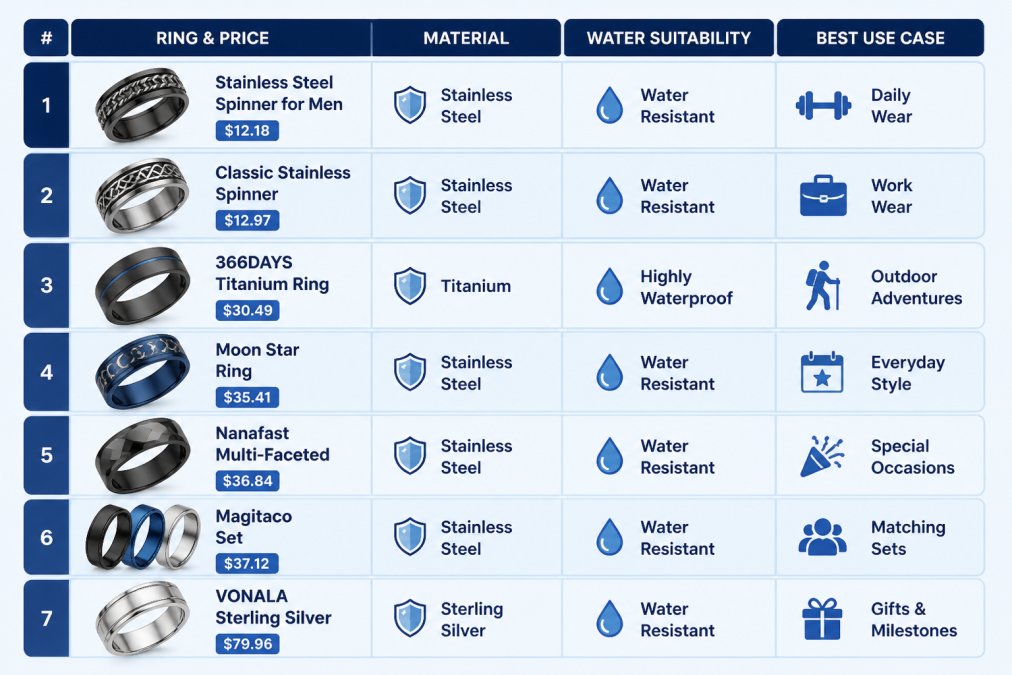
Quick Comparison: Materials, Prices, and Best For
Every piece below uses a water-resistant metal except the sterling silver ring, which needs polishing to stay bright.

| Piece | Material | Price | Water-Safe | Best For |
|---|---|---|---|---|
| Stainless Spinner (Men) | Titanium steel | $12.18 | Yes | Budget daily band |
| Classic Spinner | Titanium steel | $12.97 | Yes | Gym and office |
| 366DAYS Ring | Titanium steel | $30.49 | Yes | Sensitive skin |
| Moon Star Ring | Stainless steel | $35.41 | Yes | Stacking |
| Nanafast Ring | Titanium steel | $36.84 | Yes | Wedding band |
| Magitaco Set | 316L stainless steel | $37.12 | Yes | Variety |
| VONALA Ring | 925 sterling silver | $79.96 | Moderate | Dressy everyday |
How We Evaluated These Pieces
We judged each piece on base metal quality, water and tarnish resistance, skin sensitivity, and all-day comfort. Price factored in only as value, not durability, a $12.18 piece can outlast a $79.96 one if the metal is right.
Tarnish-Resistant Jewelry: Setting Realistic Expectations
Tarnish-resistant jewelry resists surface discoloration but isn't tarnish-proof. Stainless and titanium steel resist best because their chromium forms a protective layer. Sterling silver tarnishes because sulfur reacts with the copper in the alloy.
No metal is truly tarnish-proof. What changes is how often you clean it: a quick polish keeps sterling silver bright, while steel usually needs only a rinse.
Waterproof Jewelry: What Water-Safe Claims Really Mean
Waterproof jewelry in practice means water-resistant to daily exposure: hand-washing, rain, sweat, and quick showers. Titanium steel and 316L stainless steel handle all of that without damage.
"Waterproof" isn't a regulated term. What you're really asking is whether the metal corrodes and whether the coating survives. Solid steel and titanium: no corrosion, no coating to worry about. Plated: the coating is exactly what fails.
366DAYS Anxiety Rings for Women Titanium Steel Spinner Fidget Band Rings →
Hypoallergenic Everyday Jewelry for Sensitive Skin
Hypoallergenic everyday jewelry is made without nickel, lead, or cadmium, the metals most likely to trigger contact reactions. If your skin reacts to cheap jewelry, look for nickel-free stainless steel, titanium steel, or 925 sterling silver, and avoid plated alloy pieces with an unknown base metal.
A common mistake is blaming the metal when the real culprit is a worn plating exposing a nickel-based core. That's why solid steel and sterling silver are safer bets for sensitive skin than anything plated.
Durability by Jewelry Type: Rings, Chains, Earrings, and Bracelets
Rings take the most wear because they contact hard surfaces constantly, so choose titanium or stainless steel. Chains last well in sterling silver or steel, though clasps are the weak point. Earrings need hypoallergenic posts, and bracelets scratch against desks, so a scratch-resistant steel finish matters most there.
- Rings: highest friction, choose solid steel or titanium
- Chains: check the clasp, the most common failure point
- Earrings: nickel-free posts for sensitive skin
Care, Repairs, and Lifetime Cost of Daily-Wear Jewelry
The lifetime cost of daily-wear jewelry is lower on solid steel and titanium, which need almost no maintenance, than on plated pieces that need replacing every year or two. Sterling silver sits in the middle: cheap to polish, but it needs the attention. Repairability, warranty coverage, and replating costs decide whether a piece is a one-time purchase or a recurring expense.
Repairability by Construction
Repairability is the durability factor nobody lists in a spec sheet.
- Solid titanium and 316L stainless steel: Highly durable but harder to resize or repair than precious metals because many jewelers lack the equipment to work titanium. A steel ring that no longer fits may be a replacement rather than a resize. Buy the right size the first time.
- Solid gold and sterling silver: The most repairable category. A jeweler can resize, re-tip prongs, re-solder a clasp, and re-polish. This is why fine jewelry is often the lower lifetime-cost choice despite a higher upfront price.
- Gold-filled: Repairable in many cases, but soldering can disturb the gold layer at the joint, and not every jeweler will work on it. Ask before you buy.
Warranty and Repair Coverage: What to Ask
Warranty terms vary widely and are rarely stated clearly. Before buying, ask:
- Does the warranty cover plating wear, or only manufacturing defects? Most policies exclude normal wear, and plating wear is usually classified as normal wear.
- Is there a repair or replating service, and what does it cost?
- Who pays shipping for a repair, and what is the turnaround time?
A common pattern is a one-year defect warranty that does not cover coating wear. That should shape how much you are willing to pay for a piece.
Calculating Lifetime Cost
Compare pieces by cost per year of expected wear. A low-priced solid titanium steel ring that lasts several years can cost less per year than a plated ring that fades in months. Sterling silver costs more upfront than plated but can be polished and repaired for years. Solid gold costs the most upfront and holds the most residual value, the only category where resale is realistic.
A Simple Care Routine That Protects Lifetime Value
- Wipe pieces with a soft dry cloth after heavy wear to remove sweat and lotion.
- Put jewelry on last and take it off first, after perfume, lotion, and hair products.
- Remove plated, vermeil, and sterling silver pieces before showering, swimming, or gym sessions; solid titanium and 316L stainless steel tolerate daily water.
Frequently Asked Questions
What kind of jewelry is best for wearing every day?
Solid, non-plated metals hold up best: titanium steel, 316L stainless steel, and 925 sterling silver all handle daily wear without flaking or turning your skin green. Plated and alloy pieces look good but the coating wears through with friction and water. For a piece you never take off, pick a solid metal band or ring with a comfort fit, like the Classic Stainless Steel Spinner Ring at $12.97, and keep plated statement pieces for occasional wear.
Is stainless steel or gold better for everyday durable jewelry?
Stainless steel wins on cost and toughness. It resists scratches, corrosion, and water, and titanium steel options are hypoallergenic and won't fade or turn fingers green. Solid gold is softer, scratches more easily, and costs far more, though it can be polished and repaired indefinitely. For a gym-and-shower ring, stainless steel is the practical pick. For an heirloom, solid gold makes more sense. Gold-plated pieces sit in between and need gentler handling.
Can you shower or swim while wearing everyday jewelry?
It depends on the material. Titanium steel and 316L stainless steel pieces handle showers and hand-washing without damage. Sterling silver should come off before swimming or washing, since chlorine and soap dull the finish and speed up tarnish. Plated and alloy rings wear faster with repeated water exposure. Even with waterproof jewelry, rinse and dry pieces after pool or sea water to keep spinner mechanisms turning smoothly.
Which jewelry materials are least likely to tarnish?
Titanium steel, 316L stainless steel, and solid gold resist tarnish best. Sterling silver tarnishes naturally over time but polishes back to a bright finish with a soft cloth. Plated jewelry tarnishes once the coating thins. To slow tarnish on any piece, store it in a pouch away from humidity, keep it off perfume and lotion, and wipe it down after wear. A tarnish-resistant piece still needs occasional cleaning to stay bright.
What should sensitive skin look for in hypoallergenic everyday jewelry?
Look for nickel-free, lead-free, and cadmium-free labels, and favor titanium steel or 925 sterling silver. Nickel is the most common cause of jewelry reactions, so plated or alloy pieces are riskier for sensitive skin. The 366DAYS Anxiety Ring and the Nanafast multi-faceted band are both titanium steel and nickel-free. If a piece irritates your skin, stop wearing it and switch to a solid metal option rather than layering a coating over the problem.
Cheap jewelry that turns green is a material problem, not bad luck, and it's avoidable. Omnia X curates pieces built on titanium steel, stainless steel, and 925 sterling silver, all at competitive prices with clear material specs so you know exactly what you're getting. Browse our collection to find a durable everyday ring you can wear through showers, workouts, and everything between.