
Table of Contents
- Why Buying Quality Gold Jewelry Online in 2026 Requires a Different Approach
- 14K vs. 18K Gold: Which Karat Belongs in Your Jewelry Box?
- Gold-Plated vs. Solid Gold: What the Label Actually Tells You
- How to Verify Gold Purity and Authenticity Before You Pay
- Shopping for Solid Gold Jewelry Online: Sizing and Product Details
- Gold Jewelry Return Policy: What to Check Before You Click Buy
- Curated Picks: Quality Gold Jewelry for Every Style and Budget
- Conclusion: Buy Quality Gold Jewelry Online With Confidence
- Frequently Asked Questions
Last Updated: October 7, 2026
Why Buying Quality Gold Jewelry Online in 2026 Requires a Different Approach
Buying quality gold jewelry online in 2026 means knowing exactly what you're paying for before you click buy. At Omnia X, we put together this guide.
Here's the uncomfortable truth most buying guides skip: a "gold" label can legally describe at least four different materials, and only one of them holds its value. U.S. Federal Trade Commission guidance on jewelry marketing requires sellers to qualify plated and filled items clearly, but enforcement depends on sellers actually following the rules.
So what separates a piece you'll wear for twenty years from one that turns your finger green by summer?
Below, we'll walk through each, plus the price-per-gram math that exposes overpriced pieces.
14K vs. 18K Gold: Which Karat Belongs in Your Jewelry Box?
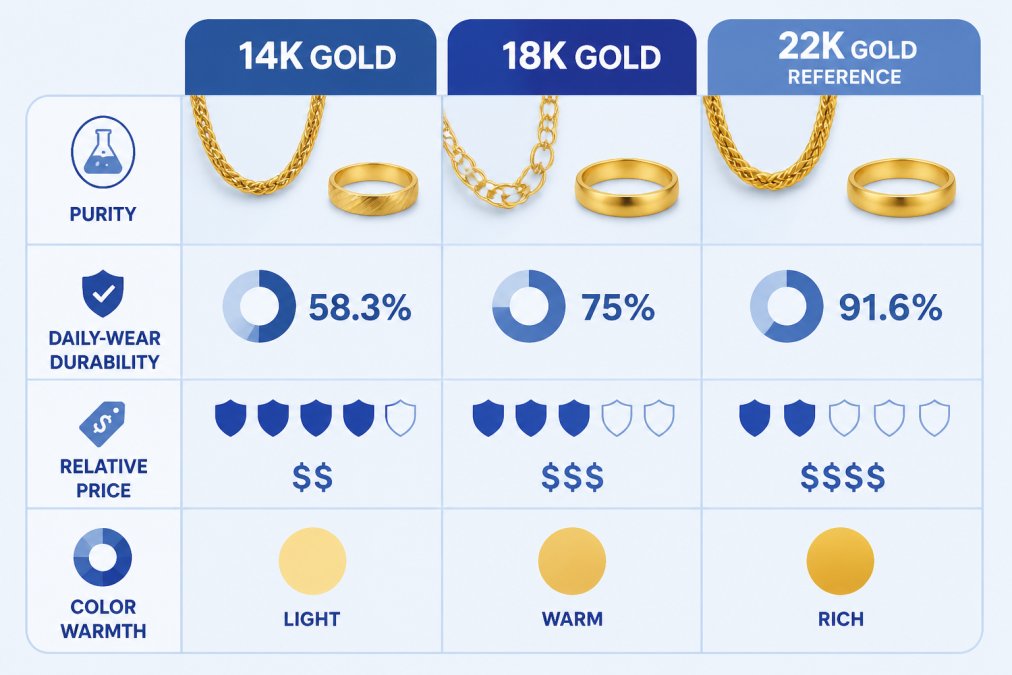
Karat measures gold purity in 24ths. 14K gold is 58.3% pure gold; 18K gold is 75%; 22K gold is 91.6%. Higher karat means more gold, softer metal, higher price.
Durability and Daily Wear
14K wins for everyday pieces. Alloyed metals (usually copper, silver, or zinc) harden the gold, so rings and bracelets hold their shape for years. 18K scratches more easily, which matters most on high-contact pieces like rings and watch bands.
For earrings, pendants, and occasional-wear necklaces, 18K's softness is a non-issue. You get richer color and more gold for your money.
Color, Cost, and Resale Value
18K reads warmer and more saturated because of its higher gold content. 14K looks slightly paler, though rhodium or alloy choices can shift the tone.
On resale, 18K generally recovers more of its metal value. But the resale market pays for gold content, not craftsmanship: a beautifully made 14K piece often resells for less than a plain 18K band of the same weight.
Gold-Plated vs. Solid Gold: What the Label Actually Tells You
The practical difference is lifespan. Plating wears through at friction points, often within months on rings. Solid gold and quality gold-filled pieces can last decades.
This is exactly why we curate Omnia X around pieces with clearly stated materials. Our Jewelry Council of America materials reference explains the industry standards for each category, and we apply them to every listing.
How to Verify Gold Purity and Authenticity Before You Pay
Verification comes down to three checks: the hallmark, the certificate, and the math. Skip any one and you're trusting the seller's word alone.
Hallmarks, Stamps, and Certificates
Look for a stamp inside the band or on the clasp: "14K," "585," "18K," or "750." The numbers are purity in parts per thousand and harder to fake than words. Reputable sellers photograph these stamps clearly.
For higher-value pieces, ask for a certificate from an independent lab, not a guarantee of beauty, but a guarantee of composition.
Price-Per-Gram Math That Reveals Value
Here's the formula: divide the asking price by the gram weight, then compare that figure to the current gold spot price for that karat. Roughly spot plus a reasonable making charge is fair; far above spot needs a very good design reason.
| Check | What to Look For | Red Flag |
|---|---|---|
| Hallmark | "585," "750," or "14K/18K" stamp | No stamp at all |
| Certificate | Independent lab verification | Seller-only "certificate" |
| Gram weight | Stated in the listing | Refuses to provide it |
| Price per gram | Near spot price plus making charge | Wildly above spot |
Shopping for Solid Gold Jewelry Online: Sizing and Product Details
Sizing errors cause more returns than quality complaints, and return shipping adds up fast. Before ordering, confirm three numbers: ring size (in millimetres of inner diameter), chain length in centimetres, and band width in millimetres.
Ring Sizing: Measure, Don't Guess
Ring size is the number one source of jewelry returns. Most online sellers list US sizes, but actual inner diameter varies by manufacturer: a US size 7 is typically about 17.3 mm, but a comfort-fit band can feel half a size larger than a standard band at the same marked size. Measure a ring you already own that fits the intended finger with a ruler or caliper, then compare that number to the seller's size chart, not a generic conversion table.
Chain and Bracelet Length: The Numbers That Matter
Chain length changes how a necklace sits, and the same length looks different on different frames. Common lengths:
- 40-42 cm (16-16.5 in): choker or collarbone length on most adults
- 45 cm (18 in): at or just below the collarbone, the most common women's necklace length
- 50-55 cm (20-22 in): below the collarbone, toward the upper chest
Bracelet sizing is similar: a standard women's bracelet is about 17-18 cm (6.5-7 in), a men's about 19-21 cm (7.5-8.25 in). Measure your wrist snugly with a soft tape, then add 1.5-2 cm for a comfortable fit, a bracelet matching your wrist exactly will feel tight and may not clasp easily.
Product Details That Separate Good Listings From Bad Ones
A listing that gives you enough information to buy confidently will include:
MINDDHA Gold Rings|Gold Rings for Women|Womens rings|Gold Band Rings →
- Gram weight for the piece, or at least for the metal portion
- Karat and material type stated clearly (solid, filled, plated, vermeil)
- Dimensions, band width, pendant height and width, chain thickness
If a listing only shows styled lifestyle shots and no close-ups, you can't verify the stamp or clasp quality. That's a red flag, not a stylistic choice.
The Pre-Purchase Detail Checklist
Before you click buy, run this quick check:
| Detail | What to Confirm | Why It Matters |
|---|---|---|
| Ring size | Inner diameter in mm, not just US size | Prevents the most common return |
| Chain length | Measured against your own neck or wrist | Length looks different on every body |
| Band width | In mm, especially for wide bands | Wide bands fit tighter |
| Gram weight | Stated in the listing | Lets you compare value and spot plating |
| Clasp type | Named in the description | Cheap clasps fail first |
| Close-up photos | Stamp, clasp, and stone settings visible | Confirms what you're actually buying |
If any row is missing, ask the seller before you pay. A seller who answers clearly and quickly is worth buying from; one who dodges the question is telling you what the after-sale experience will look like.
Gold Jewelry Return Policy: What to Check Before You Click Buy
A return window means nothing without three details: who pays return shipping, whether engraved or personalized items are excluded, and how long refunds take to land. Read those lines before checkout, not after.
The Return Policy Details That Actually Matter
Most reputable sellers offer a 14- or 30-day window. Personalized pieces, including engraved rings and birthstone items, are almost always final sale, standard practice, not a red flag. What separates a good policy from a bad one:
- Who pays return shipping. A seller who covers it is confident in the product. A seller who makes you pay both ways is passing the risk to you.
- Condition requirements. Most policies require the piece unworn, with tags attached, and in original packaging. That's normal, but it means you should inspect before wearing.
- Refund vs. store credit. Refunds to your original payment method are stronger than store credit. Check which one the policy offers.
Seller Due Diligence: A Five-Minute Check
Before you buy from any online jewelry seller, run this check:
- Read the return policy page, not just the product page. Policies sometimes differ by category or price tier.
- Look for a physical business address and a contact method other than a web form. Email and phone beat chat-only.
- Check independent reviews. Read the negative ones first on sites the seller doesn't control. A pattern of "arrived plated, not solid" or "return ignored" is a warning.
- Verify the seller's identity. Search the business name with "scam" or "reviews." A legitimate seller has a traceable history.
- Confirm the payment method offers buyer protection. This is the single most important step.
Payment Protection: What Actually Protects You
Payment method determines your recourse if the piece arrives misdescribed, damaged, or not at all.
- Credit cards offer chargeback rights under federal law in the US, and most card networks extend protection to online purchases. This is the strongest common option.
- PayPal and similar platforms offer buyer protection for items not received or significantly not as described. Check the terms, because jewelry may have exclusions.
- Marketplace platforms like Etsy or eBay have their own buyer protection, but coverage varies and often requires exhausting the seller's return process first.
What to Do If Something Goes Wrong
If the piece arrives and doesn't match the listing:
- Document everything immediately. Photograph the piece, packaging, stamp, and the listing as it appeared when you bought it.
- Contact the seller in writing. Email creates a record. State the problem clearly and ask for a specific resolution.
- Give the seller a reasonable window to respond. Most policies specify a timeframe; if not, 3-5 business days is reasonable.
- Escalate to the payment provider. If the seller won't resolve it, file a dispute with your credit card issuer or payment platform within the provider's dispute window, often 60-120 days from the transaction.
- Leave a factual review. This helps the next buyer and sometimes prompts the seller to resolve the issue.
Curated Picks: Quality Gold Jewelry for Every Style and Budget
Our picks lean toward pieces with stated materials and clear sizing.
Best for vintage character: the MINDDHA Victorian Flower Filigree Ring pairs a 10mm band with leaf filigree and a triple-layer 14K gold plated finish, and arrives in a gift-ready box.

Best for everyday sparkle: the Elegant Adjustable Sparkle Ring uses an adjustable fit, so it works across fingers and skips the sizing guesswork entirely.

Best statement piece: the Hip-Hop Gemstone Necklace sets colorful zircon stones in a gold-plated finish, sized 45-60cm for both men and women.

Best for stacking: the Hip Hop 4.0 Micro Zircon Tennis Bracelet Set comes in 17cm and 19cm lengths with seven colorways, from platinum white to 16K gold.
Conclusion: Buy Quality Gold Jewelry Online With Confidence
The gap between a good online jewelry purchase and a bad one comes down to five minutes of checking: karat stamp, gram weight, material type, sizing numbers, and return terms.
At Omnia X, every piece is curated for stated materials and honest pricing, from vintage-inspired rings to statement necklaces, all at prices that make quality accessible.
This article is for general information only and does not constitute a valuation or authentication service. Always have high-value pieces independently appraised.
Frequently Asked Questions
How can you tell if gold jewelry is good quality?
Check the hallmark or stamp first. A quality piece will be marked with its karat, such as 14K or 18K, somewhere on the clasp, band, or inner surface. Look for a stamp that includes the manufacturer's mark alongside the karat. If buying online, request close-up photos of the stamp and ask for the gold weight in grams. A seller who can provide these details is likely selling genuine gold jewelry. If the price seems far below the current gold value for that weight, treat it as a warning sign.
Is 14K or 18K gold better for everyday jewelry?
14K gold is the better choice for everyday wear. It contains 58.3% gold mixed with alloys that make it harder and more scratch-resistant. 18K gold contains 75% gold and has a richer yellow color, but it scratches and dents more easily because it is softer. If you wear a ring daily, 14K holds up better. For earrings, pendants, or occasional pieces, 18K gives you a warmer tone and higher gold content. Neither is wrong; match the karat to how often you wear the piece.
What does solid gold mean when shopping online?
Solid gold means the entire piece is made of a gold alloy, not just coated. A 14K solid gold ring is 14K gold all the way through, so it will not flake, peel, or turn your skin green. This is different from gold-plated or gold-filled jewelry, where a thin layer of gold sits over a base metal like brass or copper. When shopping for solid gold jewelry online, confirm the karat stamp and ask for the gram weight. Solid gold pieces can be resized and repaired for decades.
What should you check before buying gold jewelry online?
Before you buy, confirm four things: the karat stamp and gold weight, the return window and whether it covers worn items, the shipping timeline and tracking, and the seller's review history across multiple platforms. Also check whether the seller provides real photos rather than stock images. For plated pieces, ask about the plating thickness and base metal. A gold jewelry return policy of at least 14 days gives you time to inspect the piece and verify it matches the listing before committing.